
"We did not bathe or shave for three months and on several occasions quenched our thirst by eating ice," recalled braveheart Naik Praveen on the 26th anniversary of Kargil Vijay Diwas Saturday.
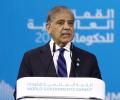
Pakistan Prime Minister Shehbaz Sharif said on Tuesday that his country respects Russia's relations with India, as he called for strengthening Islamabad's ties with Moscow during his talks with Russian President Vladimir Putin in Beijing.
'With the US having entered the war, raising the risks of a wider conflict, those impacts could be even more damaging.'

'The present generation, either due to historical amnesia or political propaganda, has been fed a narrative that paints India as an adversary rather than an ally.'

The least support for army rule is in India, the report said, adding that the support for the army rule diminishes in the countries that are educationally forefront.

For India, it is a symbol of will and a successful feat of arms.
'But that was not our aim. Our objective was already achieved.'

'There are times when India should stand up without hesitation and voice its indignation over the US' pressure tactic. This is one such moment,' asserts Ambassador M K Bhadrakumar.

Pakistan Army said on Thursday that it has 'nothing to do with politics' and it will remain apolitical in the future as well, as the powerful institution asserted that its chief General Qamar Javed Bajwa was not seeking an extension and will neither accept one.
'We should not just react when a terror attack happens on our soil.' 'Our approach should be continuous and a launch pad should be destroyed the moment it comes up.'

'India is using Hasina to warn the Yunus government because there is a ground support for the Awami League in Bangladesh.'
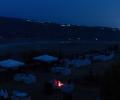
Meanwhile, a precautionary blackout has been enforfced in the multiple areas amid the esclating tensions between India and Pakistan.
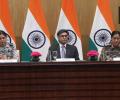
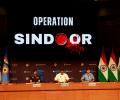
Colonel Sofiya Qureshi revealed that 300 to 400 drones were deployed across 36 locations, with several being shot down by Indian forces using both kinetic and non-kinetic methods.

'Saudi-Pak defence pact is to anchor the defence and security of Saudi Arabia and not Pakistan, per se, with Islamabad being the junior partner.'

Tahawwur Hussain Rana, a key accused in the 26/11 Mumbai terror attack case, had helped co-conspirator David Coleman Headley to obtain an Indian visa, a Mumbai police official familiar with the probe said. Rana was arrested by the National Investigation Agency (NIA) on Thursday evening following his extradition from the United States. Rana, who had served in the Pakistan Army medical corps, had emigrated to Canada in the late 1990s and started an immigration consultancy firm. He later moved to the US and set up an office in Chicago. Through his firm, Rana gave cover to Headley to carry out reconnaissance mission in Mumbai prior to the November 2008 attacks and helped him get a ten-year visa extension. During his stay in India, Headley used the front of running an immigration business and was in regular contact with Rana. There were more than 230 phone calls between the two during this period. Rana was also in touch with 'Major Iqbal', another co-conspirator of the attacks during this period, as per the NIA charge sheet. Rana himself visited India in November 2008. As per the charge sheet filed by Mumbai Police against Rana in 2023 in the 26/11 attack case, he lived in a hotel in Powai, and had a discussion about crowded places in South Mumbai with a person who has been listed as a witness in the case. Subsequently, some of these places were targeted by the Pakistani terrorists during the deadly attacks that claimed 166 lives.

People along the Line of Control and International Border in the Jammu region continue to live under the shadow of death, with unexploded mortar shells fired by Pakistani troops still embedded in farmlands and residential areas even though hostilities have stopped for nearly a week. IMAGE: Kindly note that this image has been posted for representational purposes only. Photograph: / Rediff.com Despite the May 10 understanding between India and Pakistan, locals describe the border areas as a 'death trap'. Sixty-two-year-old Balvinder Singh, who returned to his home in Pargwal sector on May 14, recounted a narrow escape. "Two shells exploded in our compound, damaging our house. Three more landed on our farmland. We were terrified and told our family to stay away from the fields until the Army could help," Singh told PTI. Army engineers later came to the village and safely defused the unexploded shells, bringing a temporary sense of relief. "Fear is writ large on the faces of people to these death traps in border hamlets", he said. Scenes of destruction are evident rooftops torn apart, broken houses, windows punctured by shrapnel, and carcasses of cattle lying in pools of blood. The acrid smell of gunpowder still lingers in the air. Sardar Gurmeet Singh faced a similar ordeal. His family could not re-enter their home as a live mortar shell had sunk into the compound in a village close to the International Border. "The army's bomb disposal squad removed it after four days, allowing us to finally enter, back home," he said. Indian Army engineers have launched a sweeping clearance operation across border districts, defusing over 80 unexploded shells in the past five days -- including 6 in Pargwal, 19 in Rajouri, 42 in Poonch, and 12 along the IB. "These shells, mostly 120 mm calibre, have a range of 15 to 30 km and pose a serious threat to both civilian and military targets," an Army officer said. "Many of them were fired by Pakistan during recent hostilities." On May 7, the Indian Army launched Operation Sindoor, conducting precision strikes on nine terror hubs in Pakistan and Pakistan-occupied Jammu and Kashmir (PoJK) in response to the April 22 terror attack in Pahalgam that killed 26 people, most of them tourists. The subsequent retaliation by Pakistan pushed the region to the brink of war. From 7 to 10 of May, 27 civilians were killed and over 70 injured in Pakistani shelling in the Jammu region. Farid Din Gujjar, a resident near the border, expressed fear about returning to his fields. "Several shells created deep craters in our paddy land. We cannot resume work until all unexploded ordnance is cleared. It's a death trap," he said. Army units, in coordination with Jammu and Kashmir Police, have evacuated high-risk zones and issued stern warnings to residents not to touch any suspicious objects or unexploded shells. In one major operation, 42 live shells were safely destroyed in the Poonch villages of Jhullas, Salotri, Dharati and Salani. "All safety protocols were followed. The shells posed a serious danger to local lives," an Army spokesperson said, calling the effort a 'continued commitment to protect civilians and restore normalcy'. Poonch saw the vast majority of deaths due to shelling. Security officials said that Pakistan used a mix of mortar shells, armed drones, and missiles during the shelling spree, specifically targeting civilian habitations and border towns in Jammu, Samba, Kathua, Rajouri, and Poonch. As clearance operations continue, the border residents are slowly returning to their homes, but with caution, fear, and lingering uncertainty about shelling that may yet happen in the future.

India and Pakistan agreed on May 10 for a cessation of firing and military activity as a result of 'direct contact' between the director generals of military operations (DGMOs) of both nations, which was 'initiated by the Pakistani side', the Centre informed Parliament on Friday.

A new book reveals that India and Pakistan discussed a communal division of Jammu & Kashmir along the Chenab river before the Kargil war in 1999.
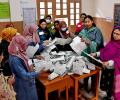
President Alvi recalled the fight for the EVMs waged by the previous PTI-led government, saying that the entire endeavour -- which involved more than 50 meetings at the presidency alone -- was abandoned.

The Pahalgam massacre highlights the evolution of terrorism into a multi-domain challenge. India's response must similarly evolve -- from tactical retaliation to comprehensive strategic deterrence. To establish a credible and sustained deterrent, India must also carry out continuous kinetic operations, both overt and covert, suggest Sakshit Raina and Rahul Mishra. To establish a credible and sustained deterrent, India must also carry out continuous kinetic operations, both overt and covert, suggest Sakshit Raina & Rahul Mishra.

Lieutenant General Vinod Khandare (retired), former principal adviser to the Ministry of Defence, discusses the implications of Operation Sindoor, including its impact on India's diplomatic relations and the need for improved civil defense.

Chief of Defence Staff Gen Anil Chauhan identifies China border dispute as India's biggest national security challenge, followed by Pakistan's proxy war. He also highlighted regional instability, future warfare scenarios, and dealing with nuclear-armed adversaries as major concerns.

China's ruling Communist Party is holding its annual leadership conclave to discuss the new five-year plan, the impact of US President Donald Trump's tariff war, and the ongoing anti-corruption crackdown in the military.
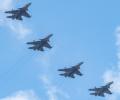
Pakistani military targets at Rafiqui, Murid, Chaklala, Rahim Yar Khan, Sukkur and Chunian were engaged using air-launched precision weapons from Indian fighter jets and the retaliation largely focused on command and control centres, radar sites and weapon storage areas, Qureshi said.

The Indian Army's para commandos killed the alleged mastermind of the Pahalgam terror attack, along with two associates, in an encounter near Srinagar.

The Indian armed forces will conduct an exercise to test the capabilities of its drones and counter-drone systems. The exercise, named 'Cold Start', will involve all three services and will take place in Madhya Pradesh.
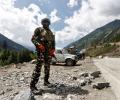
The additional troops deployed on the LoC have been successful in foiling almost all the major attempts of infiltration and terrorists have not been allowed to cross over, sources said.
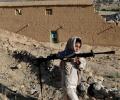
Following Pakistani airstrikes in Afghanistan's Barmal district of Paktika province, which left 46 dead and six injured, the Ministry of Foreign Affairs of Afghanistan on Wednesday summoned the Charge d'Affaires of the Pakistani Embassy in Kabul.

Recent disclosures allege large scale corruption, nepotism and kickbacks by Pakistan air chief Air Marshal Zaheer Ahmed Babar Sidhuin housing land deals in Islamabad and in buying of new aircraft, points out Rana Banerji, who headed the Pakistan desk at RA&W.

The three main political parties in Pakistan on Sunday intensified their efforts for the formation of a coalition government after it became clear that the coup-prone country faced a hung Parliament after general elections marred by allegations of rigging.
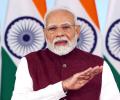
Presenting the full text of Prime Minister Narendra Modi's address to the nation on May 12, 2025, in which he dictated India's new doctrines on countering terrorism.

Another extension for General Bajwa in office at this juncture looks unlikely at this juncture, observes Rana Banerji, who headed the Pakistan desk at the Research and Analysis Wing, India's external intelligence agency.

Former ISI DG Faiz Hameed's arrest sends a strong message to PTI supporters that Imran Khan's culpability for the May 9, 2023 violence could well be drawn within the purview of military courts, especially if General Hameed turns approver to save his skin, explains Rana Banerji, who headed the Pakistan desk at RA&W.
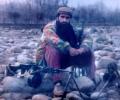
'A man with a gun commanded respect. I thought if I also got a gun, I could save my family. With this thought, I went to Pakistan and got training there'
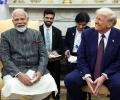
Congress general secretary Jairam Ramesh said Modi should take inspiration from former prime minister Indira Gandhi and stand up to the president of the United States.

In a post on X, the additional directorate general of public information posted: "Pakistan again violates the Ceasefire Agreement by firing artillery in Bhimber Gali in the Poonch-Rajouri area. Indian Army is responding appropriately in a calibrated manner."
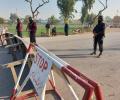
According to the Inter-Services Public Relations, the media wing of the army, the terrorists attacked the security post in Dera Ismail Khan's Daraban area bordering the South Waziristan tribal district in the early morning hours.

General Bajwa, who commanded the 10 Corps that looks after Pakistan's border with India, is unlikely to change his army's and nation's policy on Kashmir,' says Ambassador M K Bhadrakumar.

Prime Minister Narendra Modi accused the Congress party of supporting terrorists groomed by Pakistan and protecting infiltrators during a rally in Assam. He also highlighted development projects undertaken by the BJP government in the state.
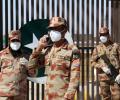
Sources in PoK reveal that special quarantine centres have been set-up in Mirpur and other major cities in the occupied regions to cleanse the Punjab province of COVID-19 patients as Army top brass has ordered that no positive patient should be anywhere near where Army facilities and Army family housing is there.
